



Have you ever noticed a thickening in your palm or felt your fingers slowly curling inward without pain? It can feel subtle at first — almost harmless — until it starts affecting everyday tasks like shaking hands or putting on gloves. This condition is often referred to as loguytren problems, a common misspelling of Dupuytren’s contracture.
Loguytren problems refer to a hand condition medically known as Dupuytren’s contracture, where the connective tissue under the skin of the palm thickens and tightens over time, causing fingers (usually the ring and little finger) to bend toward the palm.
In this guide, we’ll break down what causes it, how it progresses, and what treatment options are available — in clear, simple language.
What Are Loguytren Problems?
Loguytren problems occur when the palmar fascia — the layer of tissue beneath the skin of your palm — becomes abnormally thick and tight.
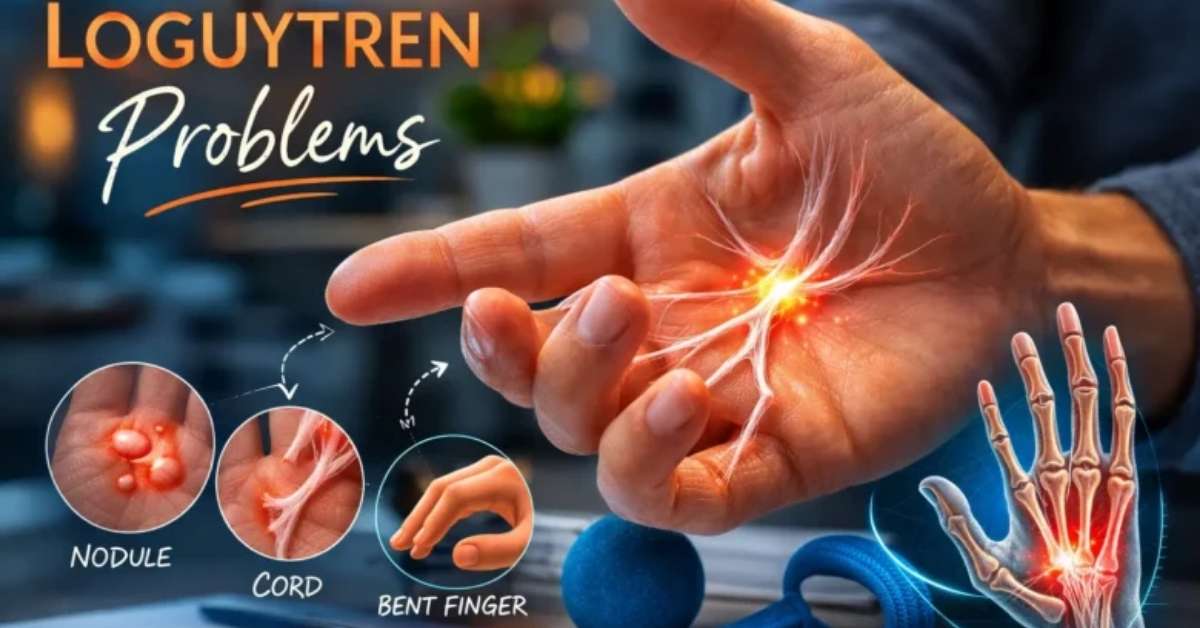
Over time, this thickening forms:
- Small lumps (nodules) in the palm
- Rope-like cords under the skin
- Finger contractures (fingers stuck in a bent position)
The condition progresses slowly and is usually painless, which is why many people ignore early signs.
Another Name for Loguytren Problems
The correct medical term is Dupuytren’s contracture.
It’s named after the French surgeon Baron Guillaume Dupuytren, who described it in the 19th century.
What Causes Loguytren Problems?
The exact cause isn’t fully understood, but research points toward a combination of genetic and environmental factors.
1. Genetics (Strongest Risk Factor)
If someone in your family has Dupuytren’s contracture, your chances increase significantly. It’s especially common in people of Northern European descent.
2. Age
Most cases develop after age 40. The risk increases with age.
3. Gender
Men are more likely to develop loguytren problems than women — and often at a younger age.
4. Medical Conditions
Certain health issues are linked with higher risk:
- Diabetes
- Epilepsy
- Liver disease
- Alcohol misuse
5. Lifestyle Factors
While not direct causes, these may increase risk:
- Smoking
- Excessive alcohol use
- Repetitive hand trauma (though evidence is mixed)
Early Signs and Symptoms
Loguytren problems usually begin quietly. Many people don’t notice them at first.
Early Symptoms
- Small lump in the palm
- Slight thickening of skin
- Mild tightness
These lumps are typically painless but may feel tender initially.
Advanced Symptoms
- Fingers (especially ring and little finger) bend inward
- Difficulty placing hand flat on a table
- Trouble gripping objects
- Reduced hand flexibility
A simple self-test: try placing your palm flat on a table. If you can’t fully flatten it, contracture may be developing.
Stages of Loguytren Problems
Doctors generally describe progression in stages:
Stage 1: Nodule Formation
Small bumps form in the palm.
Stage 2: Cord Development
Fibrous cords form under the skin.
Stage 3: Finger Contracture
Fingers begin bending toward the palm.
Stage 4: Severe Contracture
Fingers may become permanently bent and interfere with daily activities.
The condition progresses slowly — sometimes over years or even decades.
How Is It Diagnosed?
Diagnosis is usually straightforward.
A healthcare provider will:
- Examine your hand
- Check finger movement
- Perform the “tabletop test”
- Assess family history
In most cases, no imaging (like X-rays or MRI) is required.
Treatment Options for Loguytren Problems
Treatment depends on severity and how much it affects your life.
1. Watchful Waiting
If symptoms are mild and not interfering with function, doctors may recommend monitoring only.
Since it’s painless in many cases, immediate treatment isn’t always necessary.
2. Non-Surgical Treatments
These are commonly used in moderate cases.
Collagenase Injections
An enzyme is injected to break down the thickened cords. The finger is then manually straightened.
Needle Aponeurotomy
A minimally invasive procedure where a needle breaks up tight cords under the skin.
Benefits:
- Quick recovery
- Minimal scarring
- Done under local anesthesia
3. Surgery (Advanced Cases)
In severe contracture, surgical removal of the affected tissue may be required.
Recovery may take weeks to months and often involves:
- Physical therapy
- Splinting
- Hand exercises
Surgery has longer-lasting results but comes with higher recovery time.
Can Loguytren Problems Be Cured?
There is currently no permanent cure for Dupuytren’s contracture.
However:
- Treatments can significantly improve finger movement
- Symptoms can be managed
- Early intervention prevents severe deformity
Recurrence is possible, especially in younger patients.
READ MORE >>> UploadArticle Register Guide: How to Sign Up and Submit Articles
Living with Loguytren Problems
If diagnosed, don’t panic. Many people live comfortably with mild forms.
Helpful tips:
- Perform regular hand stretching exercises
- Avoid excessive gripping strain
- Manage diabetes if present
- Stop smoking
- Limit alcohol intake
Early monitoring makes a big difference.
When Should You See a Doctor?
Seek medical advice if:
- You cannot flatten your palm
- Your fingers are bending noticeably
- Daily tasks become difficult
- The condition worsens quickly
Early treatment is usually simpler and less invasive.
FAQs About Loguytren Problems
1. Are loguytren problems painful?
Usually not. Most people experience little to no pain, especially in early stages.
2. Is Dupuytren’s contracture arthritis?
No. It affects connective tissue under the skin, not the joints.
3. Can hand exercises reverse it?
Exercises may help maintain flexibility but cannot reverse thickened tissue.
4. Does it affect both hands?
Yes, it often affects both hands, though one may be worse.
5. Is it dangerous?
It’s not life-threatening but can impact hand function significantly.
Conclusion: Understanding Loguytren Problems Early Matters
Loguytren problems, medically known as Dupuytren’s contracture, may start as a small lump in the palm but can gradually lead to finger contracture if left untreated.
The good news? It progresses slowly, is often painless, and has several effective treatment options — from minimally invasive injections to surgery.
If you notice early signs, don’t ignore them. Early diagnosis leads to easier treatment and better outcomes. Keep an eye on your hand flexibility, and consult a healthcare provider if symptoms begin to interfere with daily life.
Taking action early can help you maintain full use of your hands for years to come.